
Westfield City Directory Collections
The Westfield Athenaeum Local History and Genealogy collection is the key local shelf for historical directories. Its guides describe city directories from 1873 through 1989 in the Reference Room, along with street listings, tax lists, newspapers, maps, family material, cemetery records, and selected residential-building information. The State Library catalog independently verifies selected Westfield runs through 1943, but it does not verify a separate volume for every year in the Athenaeum span. Check the volume and its condition with a librarian before treating a year as available.
| Collection | Years | Where Held | Access |
|---|---|---|---|
| Westfield city directories | 1873-1989 | Athenaeum Reference Room | In person; confirm individual years |
| State Library cataloged Westfield runs | Selected volumes, 1873-1943 | Massachusetts State Library catalog | Catalog confirmation of listed runs |
| Westfield street listings | 1930-present | Athenaeum | House number, names, and occupations |
| Westfield tax lists | 1894-1929 | Athenaeum | Street and taxpayer order |
Ridley's Westfield Directory, published in 1873, is the verified early title. A local history reports an announcement in late 1872. Later publisher names were not consistently verified in the official catalog material, so they are not assigned here. There is also no verified last-print date or complete publisher sequence beyond the Athenaeum's stated directory run.
Westfield Directory Shelf Access
The Athenaeum's local-history room is open whenever the library is open, and ordinary research does not require an appointment. Staff welcome family and home-history questions in person, by phone, email, or mail. Its broader holdings make it practical to check a directory entry against newspaper microfilm, town histories, copied vital material, yearbooks, photographs, church records, diaries, or local maps without assuming that one directory line settles the question.
The Athenaeum's family-history research information identifies the directory and street-list holdings alongside other local sources.
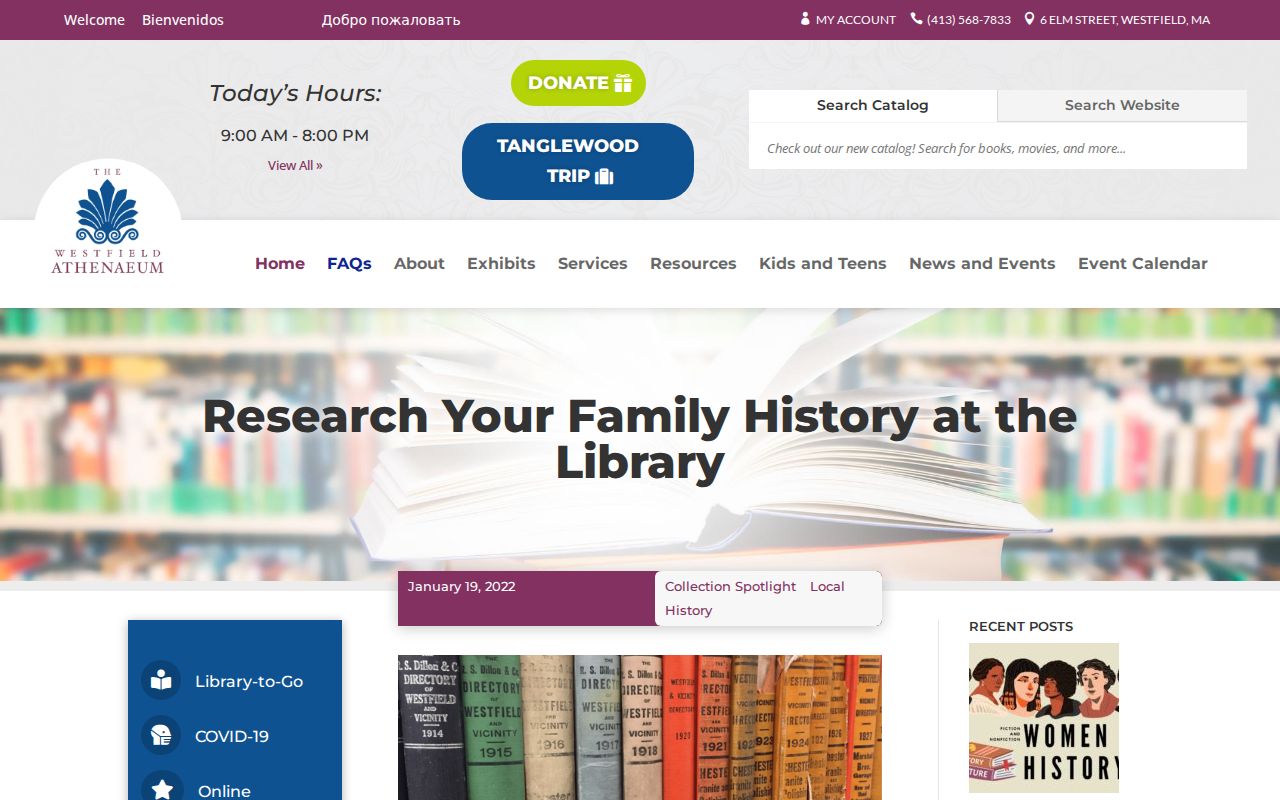
Use the collection description as an access lead, not as evidence that any specific directory page is online or searchable from home.
The Athenaeum local-history service also identifies newspapers on microfilm from 1782 to the present and miscellaneous Westfield records on microfilm from 1658 to 1850.
Those nearby collections can test a name, an address, or an event that a city directory only hints at.
The family-history holdings add Massachusetts town vital statistics through 1850, copied Westfield birth, marriage, and death material from City Hall in the 1700s and 1800s, and an obituary index for the Westfield News beginning in 1977. The collection also lists high-school yearbooks, historical-map reproductions, town histories, family material, cemetery records, photographs, nearby-town histories, diaries, journals, and church records. Each source has a narrower purpose than a directory, which makes it useful as a separate test rather than a replacement for the printed entry.
Westfield residents can use CW MARS, and Massachusetts residents can obtain a free Boston Public Library eCard for additional licensed genealogy access. FamilySearch, the Massachusetts State Archives, the Western Massachusetts Genealogical Society, and the Digital Microfilms Archives are also named by the Athenaeum as research routes. Licensed databases and collection access can change, so current availability belongs with the library staff.
Reading Westfield City Directory Entries
Westfield's local guides verify a modest but useful entry inventory. The alphabetical directories give a resident name, profession or occupation, and street address. Street lists add house number, names, and occupations. An occupation can help separate two people with the same surname, while the address links the entry to a street list, tax list, census image, or deed research.
| Alphabetical name | Directories are arranged by surname; preserve initials and spelling as printed. |
|---|---|
| Profession or occupation | A distinguishing clue when a name is common. |
| Street address | The bridge to the address-based records and maps. |
| Street-list house number | Available in the 1930-present street-list material. |
| Names and occupations in street lists | Useful for associating an address with historical occupants. |
- Street list
- An address-ordered local listing that identifies house numbers, names, and occupations in the verified Athenaeum run.
- Directory entry
- A name-ordered historical listing with the verified name, occupation, and address fields.
- Printed form
- The spelling, initials, and street style exactly as a volume shows them. Preserve it before trying a normalized search variant.
The local sources did not expose one transcribed Westfield entry. Exact abbreviations, spouse conventions, employer fields, homeowner markers, widow notation, and page placement remain unverified. Do not read those features into a Westfield entry until the actual volume is inspected.
Westfield Directory Household Trails
A city directory is strongest when it becomes one part of a household trail. Begin with an address in a 1930-present street list, then find the surname in the nearest directory volume. Copy every printed version of the name, the initials, the occupation, and the address. Keep the original wording and a separate search form. A disappearance can be a move, a death, a changed spelling, or a gap in the surviving run.
- Check two or three adjacent volumes, not just one date.
- Compare directory years with the 1900, 1910, 1920, 1930, 1940, and 1950 federal census images where available.
- Use names, ages, birthplaces, and the census address to test whether the entries identify the same household.
- Use the 1894-1929 tax lists as a street and taxpayer cross-check, then use deed research for legal ownership.
- Look for an obituary or newspaper notice when a name stops appearing.
Federal population schedules were taken every ten years from 1790, with personal schedules public through 1950 under the 72-year rule. Most 1890 schedules were destroyed, so Westfield directories, tax lists, deeds, newspapers, and later census years are especially useful around that national gap.
Note: An address or occupation supports identification, but it does not prove every person in a household.
Westfield Directory-Era Newspapers
Digitized newspapers can explain changes seen in a city directory. A September 2020 account of the Athenaeum project reported 9,184 searchable pages of the Valley Echo, 6,308 pages of the Times and News-Letter, 6,117 pages of the Westfield Evening Journal, 4,017 pages of the Westfield News Letter, 2,072 pages of Western Hampden Times and Westfield News-Letter, and 1,554 pages of the Hampden County Leader. These are newspaper totals, not directory volumes.
Westfield Digital Microfilms Archives is a community-history route identified by the Athenaeum.
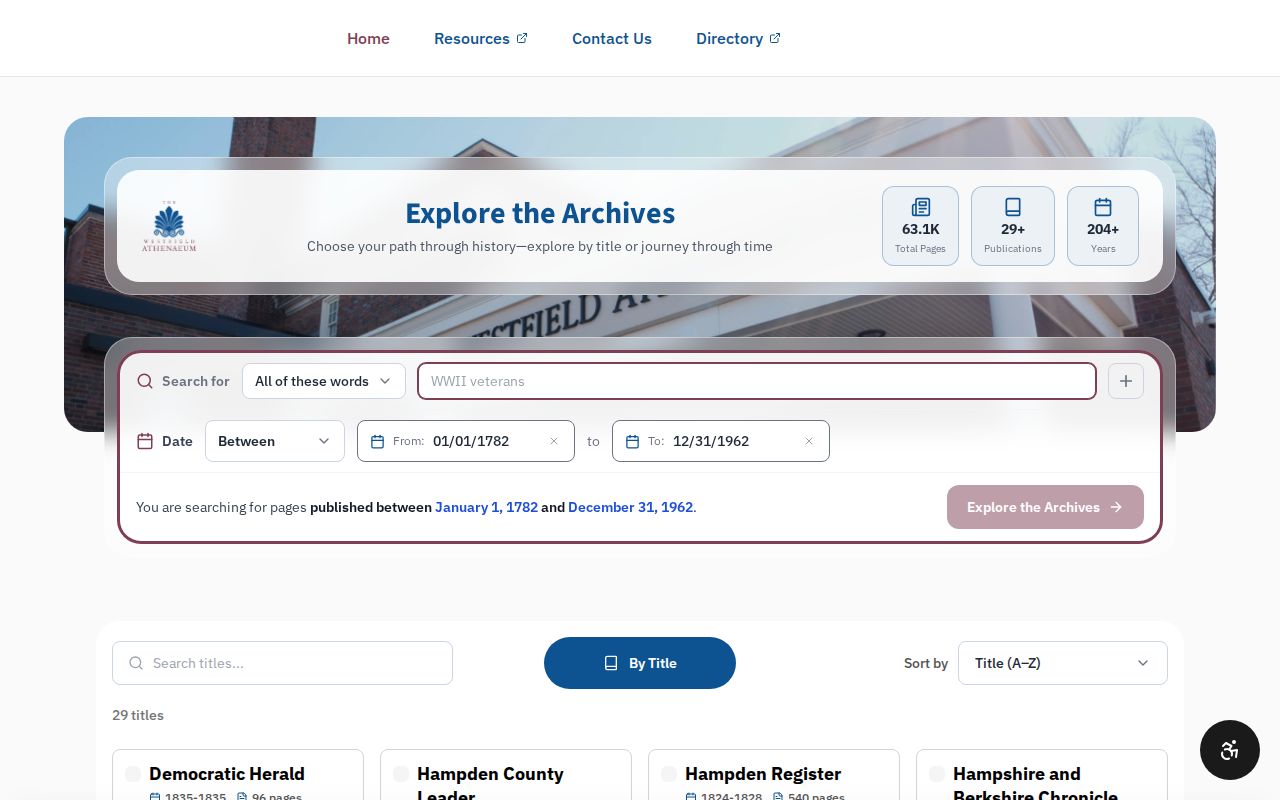
A notice may provide a date for a move, death, marriage, business change, or community event, then the directory and census can be checked against that lead.
The digitized archive does not change the directory access limit: no public digitized scan of a Westfield city directory was verified. The historical directories remain an Athenaeum reference collection unless a librarian confirms otherwise.
Westfield Archives Beyond Directories
The Donald Blair Research Center extends the local record trail into late-1600s material. Its holdings include First Congregational membership books from 1667 to the present, a Masons directory from 1888 to 1963, almshouse admissions from 1902 to 1941, a Washington Street Hotel register from 1923 to 1935, school records, Fire Department records, and a City Hall businesses card file from 1908 to 1948. These sources document affiliation, attendance, admission, or a business connection rather than a universal roster of residents.
The Donald Blair Research Center holdings index is the starting point for specific archival groups.
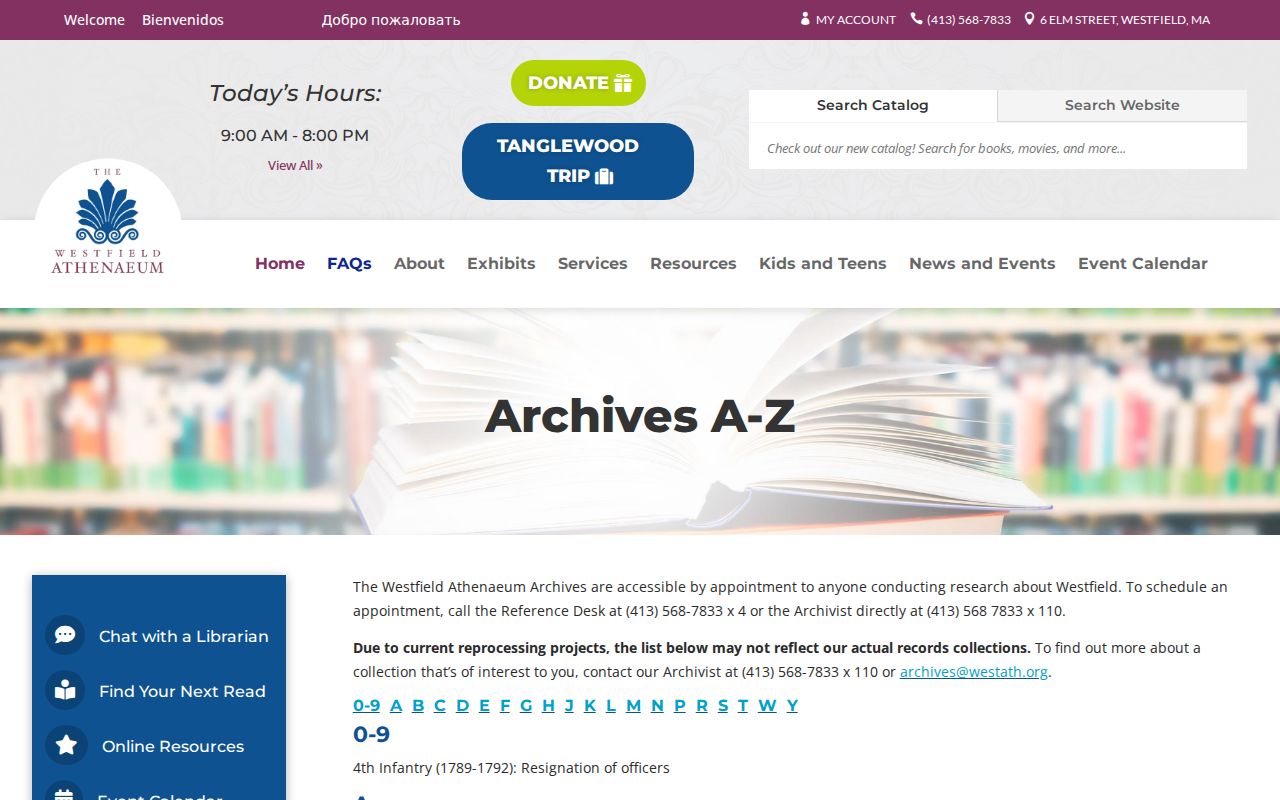
Some archive visits may require an appointment. The local-history librarian and archives staff provide the current contact route, so check before relying on a particular file's availability.
The archive range also includes Chamberlain police, constable, court, and truant-officer records from 1866 to 1877; school material from 1793 to 1980; H.B. Smith Company records from 1850 to 1978; Board of Public Works minutes from 1921 to 1938; and family deeds and business ledgers. A directory entry may point toward one of these sources through an address, occupation, organization, or date. It does not establish that a related archive file contains a particular person until the finding aid or record is examined.
Westfield Directory Research Endpoints
When a person leaves the directory record, the Athenaeum's Westfield News obituary index begins in 1977, while its newspapers and archive files reach much further back. The Old Burying Ground inventory supplies more than 1,400 names, death dates, ages, family notes, additional notes, and source citations. Its compiler compared the inventory with an 1880s Henry Holland journal, making it a useful historical lead rather than a complete citywide interment database.
Match a cemetery or obituary lead to a certificate, probate matter, newspaper image, or grave record before treating it as final identification. Historic directories can track a person between those endpoints, but their coverage and wording must be preserved exactly.
Research tip. Separate a printed directory entry from a later conclusion. Record the volume year, name spelling, occupation, address, and the second source used to test it.
Westfield City Directory Limits
Westfield became a city in 1920, but local records reach further back through town material, church books, newspapers, and microfilm. The first verified local printed directory is the 1873 Ridley's volume. Neither a complete publisher history nor a verified final printed year was found, and the State Library catalog should not be read as a complete shelf inventory. These gaps matter when a search appears to skip a year.
Use the Athenaeum's stated 1873-1989 run as the local starting range, confirm the volume on hand, and retain uncertainty where the source does. A city directory records what its publisher printed for that edition, not an official count of all Westfield residents.