
Westfield Previous Residents Sources
Past residents of one Westfield address can appear in separate record sets that prove different things. The city assessor and GIS begin the trail with a present parcel and owner or mailing clues. The Registry supplies legal instruments and parties. Athenaeum directories, street lists, and tax lists add historical address evidence. Census schedules capture a household at a point in time. Keep owner, occupant, household member, and address as separate propositions until the records support a connection.
| Source | Years It Covers | Where Held | What It Shows |
|---|---|---|---|
| Hampden Registry deed index | 1636-today | Hampden Registry of Deeds | Recorded parties, legal description, book and page |
| Westfield city directories | 1873-1989 | Athenaeum Reference Room | Name, occupation, and address |
| Westfield street lists | 1930-present | Athenaeum | House number, names, and occupations |
| Westfield tax lists | 1894-1929 | Athenaeum | Street and taxpayer order |
| Federal population census | Public through 1950 | NARA and library genealogy access | Household names and related census fields |
Start at the period that matches the question. A recent title trail belongs with the Registry. A question about historical occupants calls for a street list or directory, then a census image. The city permit route began using OpenGov on July 1, 2026, but public historical coverage and search controls were not verified, so permit files should not be assumed to fill an earlier gap.
Westfield Deed Records Trail
The Hampden Registry search instructions separate the fast post-1948 search from the older scanned-index process. Property records are maintained from 1636 to today. For documents recorded after January 1, 1948, the Registry permits searches by name, address, book and page, year and instrument number, or entry date. A deed is a legal record of a transfer, not proof that every listed party lived at the property.
The Registry's search instructions show the route used for a recorded-document trail.
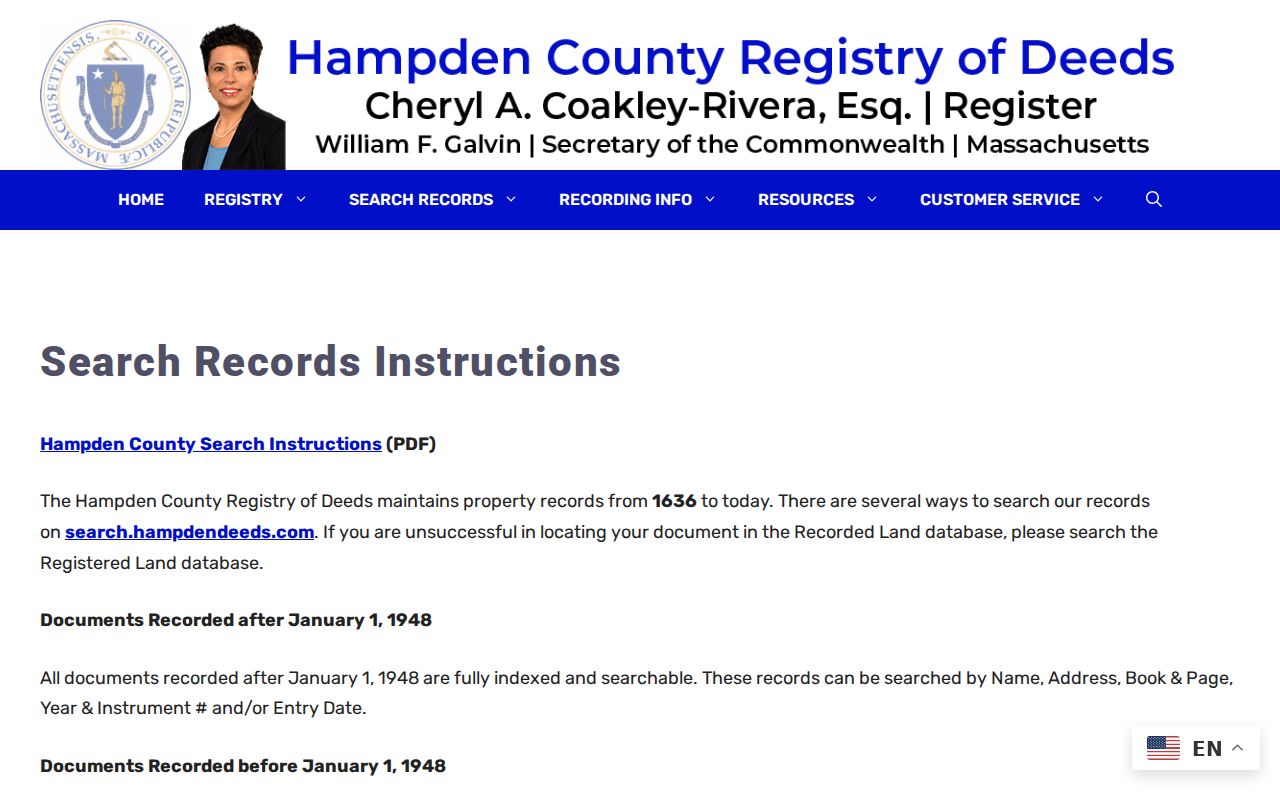
Begin with an assessed owner or parcel cross-reference, then use the purchase instrument to identify the seller and the legal description. The city assessor and the Registry are separate sources, and their fields should not be treated as interchangeable.
The Hampden deed index is the online entry to the recorded instruments.
The document image, its book and page, and its legal description provide the evidence needed for the next backward step.
- Locate the current parcel and record the owner, site address, and Registry cross-reference where available.
- Find the owner's purchase deed and copy the recording date, book and page, seller, and legal description.
- Search the seller as a grantee to find how that person acquired the same property.
- Repeat the sequence, preserving every book and page rather than relying on an address alone.
- When the chain reaches a pre-1948 record, change to the scanned grantor or grantee index process.
Westfield Pre-1948 Deed Records
The key divide in a Westfield address history is January 1, 1948. Earlier records are online, but the Registry requires a researcher to use scanned grantor or grantee index pages, read the entry, capture the book and page, and then open the image through a book-and-page search. The instructions direct a researcher through Registry Records, Scanned Index, Grantor or Grantee, surname, optional year range, the result pages, and the book icon. It is slower, but the research does not end there.
The scanned grantee index is the route for locating an earlier acquisition.
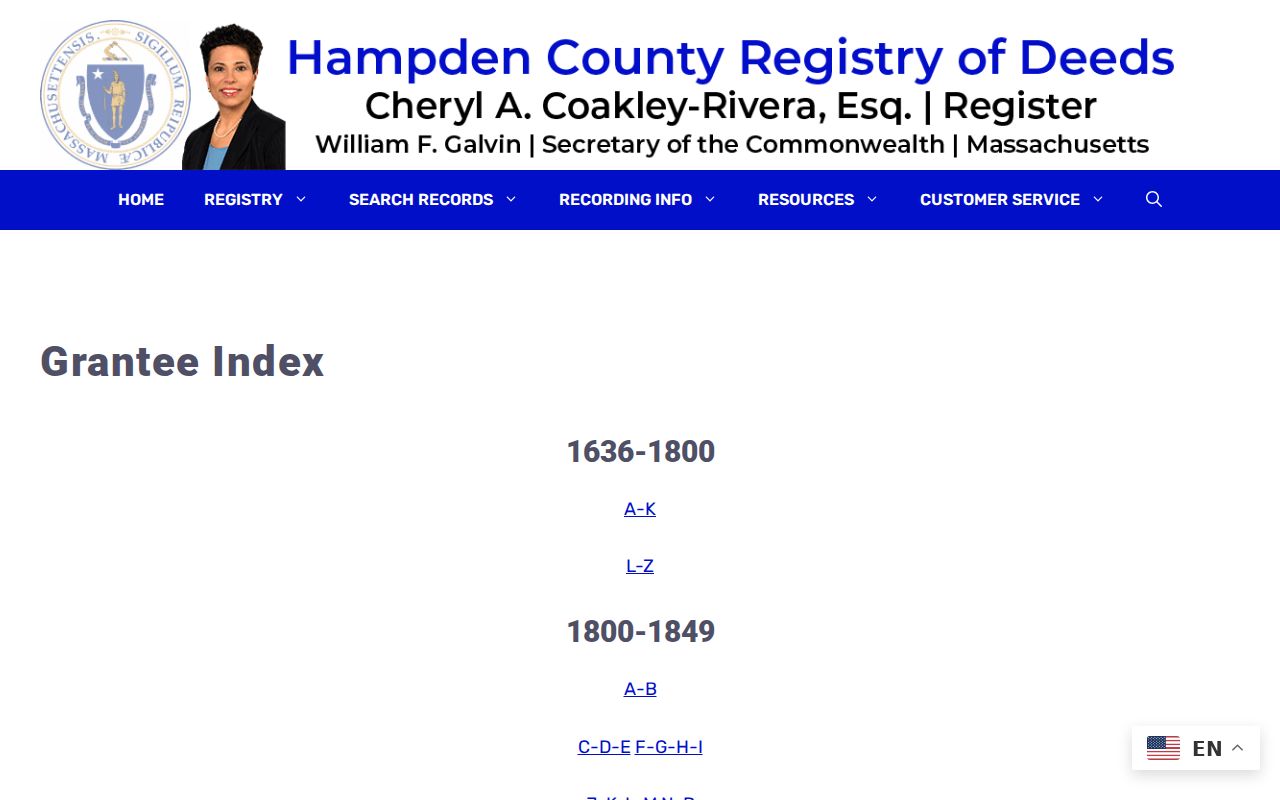
Search the person receiving the property to locate the earlier purchase. Record the index page and book and page before moving to the instrument image.
The scanned grantor index is the paired route for a recorded conveyance away from the property.
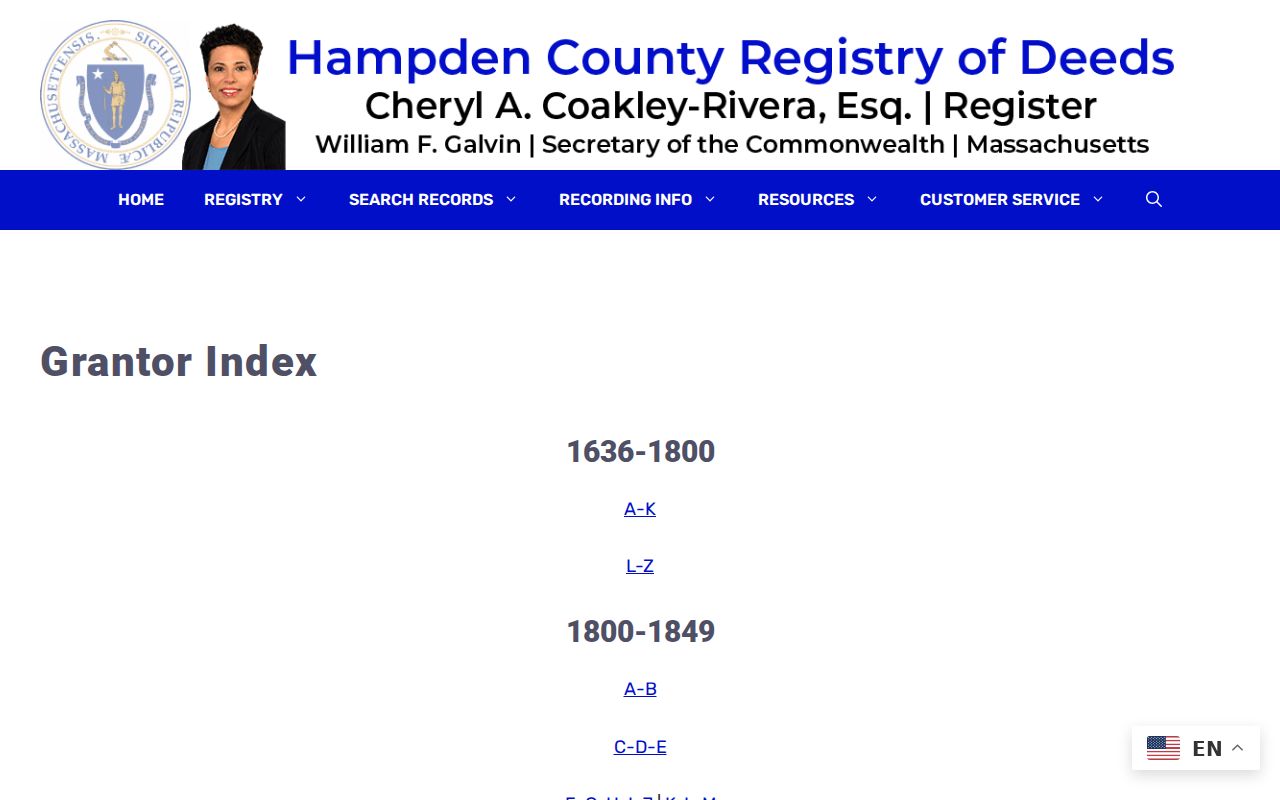
Use both directions when a name changes, an estate is involved, or the address fails to return a clear record. Registry guidance also notes that an inherited property may pass through probate rather than a new deed.
- Grantor
- The party conveying an interest in a recorded instrument.
- Grantee
- The party receiving an interest in a recorded instrument.
- Chain of title
- The sequence of recorded transfers used to trace legal interests in a parcel.
- Legal description
- The lot, plan, metes-and-bounds, municipality, or prior book-and-page description used in the deed. It can remain useful when a street form changes.
Westfield House History Records
The Athenaeum's house-history guidance brings the address trail back to the people who used a place. It identifies most Westfield city directories as running from 1871 to 1989, while the library's family-history material states 1873 to 1989. The source conflict should remain visible: use the physical volume and librarian confirmation for a particular year, rather than selecting one range as a substitute for the other. The same guide places tax lists from 1894 to 1929 by street and taxpayer, with street lists after 1929 showing streets, house numbers, names, and occupations.
The Westfield house-history guide also identifies Sanborn maps, historic-house lists, vertical files, and local street studies.
The exact Westfield years for Sanborn maps were not verified. A catalog check is needed before assigning a map date to a house or using a map as proof of an occupant.
Westfield Previous Residents by Household
Directories and census schedules answer different questions. The Athenaeum city directories are alphabetically arranged and give a name, profession or occupation, and address. Its street listings, available from 1930 to the present, give a house number with names and occupations. Federal census records can include household names, ages, birthplaces, immigration year, street address, marriage status, occupation, and home value from 1850 through 1950. Pair the sources instead of treating either as a complete roll of everyone who lived at a Westfield address.
For collection details and entry-reading limits, use the Westfield city directory collections. For an address trail, the practical flow is: street list or directory address, then nearby directory volumes, then the matching census year, then a tax list or deed if an ownership question remains.
- Copy the name, initials, occupation, and address exactly as the directory or street list prints them.
- Check two or three adjacent directory volumes for moves or spelling changes.
- Pair the result with the nearest available 1900, 1910, 1920, 1930, 1940, or 1950 census schedule.
- Compare the household fields with the address and occupation before joining the records.
- Use tax lists from 1894 to 1929 and the Registry chain as separate checks.
- Criss-cross listing
- An address-ordered historical listing used to move from a house number toward names. Westfield's verified local material is described as street listings.
- Enumeration district
- The census area used to organize a population schedule. It helps narrow a census search but does not itself identify a household.
Westfield Address Record Continuity
An old address may not search cleanly in a modern index. No official Westfield citywide street-renumbering or renaming year was located. The 2026 city street map has an A-S and 1-13 grid and a street index, but it does not establish a renumbering history. Preserve the old printed street form, search the deed's legal description and prior book and page, test nearby house numbers, and compare older street lists or maps.
GIS fields distinguish the parcel situs from the owner's mailing address. Registry legal descriptions can use a lot or plan, metes and bounds, municipality, or prior book and page. That stability makes the legal description valuable when a numbered address, street spelling, or municipal boundary assumption leads nowhere.
Note: A current mailing address, a recorded owner, and a historic directory occupant are not the same fact.
Westfield Past Residents Endpoints
When a household stops appearing in Westfield records, the Athenaeum's Westfield News obituary index begins in 1977. Digitized local newspapers, library microfilm, and archives can supply a lead about a death, marriage, move, or estate. The Hampden Probate and Family Court holds estate proceedings, wills, estate petitions, guardianships, and family matters. A deed of distribution can connect probate activity to the land-record chain.
An obituary is a lead, not a title opinion. A probate file, certificate, or recorded deed supplies a stronger cross-check. The 1890 federal census loss makes these local substitutes particularly valuable for a Westfield history that crosses that gap.
Registry staff cannot draft instruments or provide legal advice. A deed copy may be printed from the Registry website, while certified copies require a call or visit. The Registry also cautions that a name in a grantee field is an index lead, not a legal title opinion. Keep that distinction when an estate, release, lien, mortgage, or other recorded instrument appears in the chain.
Westfield Digital Microfilms Archives is one of the local historical research routes named by the Athenaeum.
Search a newspaper by the address, street, surname, and occupation only after retaining the directory's printed spelling. The result may clarify a change, but it should be tested against the deed or census record.
Westfield Previous Residents Limits
Previous-resident research is appropriate for family history, estate questions, and personal curiosity. It does not authorize tracking a living person, seeking protected addresses, or treating archival references as a current location. Address Confidentiality Program participants may use a substitute address, and restricted records cannot be bypassed through a name or property search.
Lawful use. Massachusetts public records do not permit harassment, monitoring, threats, or publication of sensitive details. M.G.L. c.265 §43 addresses stalking, and criminal harassment is addressed in §43A.